
You want to keep your family cool and safe during the next Gulf Coast storm, but you might feel confused by the technical numbers. We have spent 10 years helping Houston homeowners navigate these choices, and we know that an incorrectly sized unit is a recipe for disaster. This Whole-House Generator Sizing Guide will show you exactly how to pick a machine that handles your entire lifestyle without breaking a sweat. Whether you live in a cozy suburban home or a large estate, we want you to have the confidence that your power will stay on when the hurricane winds start to howl.
Selecting the Right Generator Capacity
Choosing the correct generator capacity is vital for surviving long-term outages in hurricane-prone regions like Houston and Kingwood. This guide explains how to calculate your home’s total electrical demand, focusing on high-draw appliances like air conditioners and well pumps. By understanding peak wattage and continuous loads, you can select a unit that prevents system overloads during extreme weather. We cover the specific needs of different home sizes and the impact of fuel types on overall performance. Using a professional load calculation ensures your backup power remains reliable when the local grid fails.
The Danger of Guessing Your Power Needs
We often see people buy a generator based purely on the square footage of their home, but that is a dangerous mistake. Your neighbor might have a 2,000 square foot house with gas appliances, while you have the same size house with all-electric heating and a pool pump. Your power needs will be vastly different. If you choose a unit that is too small, it will shut down the moment your AC tries to kick on during a 100-degree afternoon. We use a professional load calculation for standby generator projects to ensure your system has enough “headroom” to start your heaviest motors without tripping the breaker.
Understanding Your Electrical Capacity Needs
To help you visualize the different power tiers, we created this table based on common Houston property profiles. These estimates give you a starting point for your project.
| Home Profile | Typical Square Footage | Recommended Generator Size | Key Appliances Powered |
| Small Home / Condo | 1,000 – 1,500 sq ft | 10kW – 14kW | Lights, Fridge, Small AC, Electronics |
| Average Suburban Home | 1,800 – 2,500 sq ft | 18kW – 22kW | 3-5 Ton AC, Kitchen, Laundry, Lights |
| Large Family Home | 2,600 – 4,000 sq ft | 24kW – 26kW | Dual AC Units, Well Pump, Pool, Luxury Kitchen |
| Estate / Commercial | 4,500+ sq ft | 30kW – 48kW+ | Full House Coverage, Guest House, Elevators |
How to Calculate Home Power Load Like a Pro
You can start your own assessment by looking at the “Starting Watts” versus “Running Watts” of your appliances. Starting watts are the huge bursts of energy needed to get a motor spinning, like your air conditioner compressor. When we teach clients how to calculate home power load, we tell them to list their “must-have” items first.
Take your largest motor’s starting wattage and add it to the running wattage of everything else you want to operate. This total gives you a baseline for your generator wattage requirements for home use. We always recommend adding a 20% safety margin to this number so your generator doesn’t run at 100% capacity for days at a time.
Specific Needs: Generator Size for a 2,000 sq ft House
A very common question we hear is about the ideal generator size for a 2,000 sq ft house. In the Kingwood and Houston area, a 22kW air-cooled unit is usually the “sweet spot” for this size. This capacity allows you to run a 5-ton central air conditioner while still using your microwave, hair dryer, and television. If you try to go smaller, you might have to practice “load shedding,” where you manually turn off the water heater just to use the stove. Most of our clients prefer the seamless experience that a 22kW unit provides during a stressful storm.
Sizing for Extremes: Generator Sizing for Hurricane Areas
Hurricane season brings unique challenges that a standard whole-house generator sizing calculator might miss. You aren’t just looking for a few hours of backup; you might need to run your unit for two weeks straight. In these scenarios, the engine’s ability to stay cool is just as important as its power output. We focus on generator sizing for hurricane areas that account for the extreme heat and humidity of a Texas summer. A unit that is slightly oversized will run at a lower RPM or under less stress, which extends the life of the engine and saves you on fuel costs over a long outage.
Natural Gas vs Propane Generator Sizing Factors
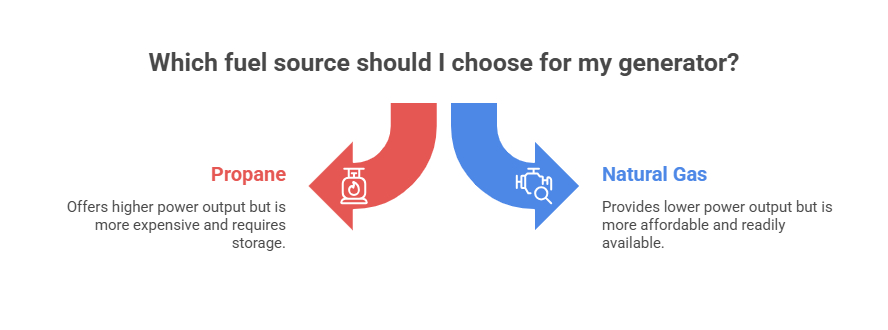
Did you know that your fuel choice affects the power output of your machine? When we look at natural gas vs propane generator sizing, we have to account for “derating.” Engines typically produce about 10% to 15% less power when running on natural gas compared to liquid propane. If a generator is rated for 22kW on propane, it might only give you 19.5kW on natural gas. We always check your gas meter capacity during our site visit to ensure your home’s plumbing can deliver enough fuel to keep the generator running at full strength during a blackout.
Matching Your Transfer Switch Size for Whole-House Generator Use
The “gatekeeper” of your power system is the transfer switch. You must match your transfer switch size for a whole-house UPS to your home’s main electrical service. If you have a 200-amp main breaker panel, you generally need a 200-amp automatic transfer switch. This allows the switch to handle the full load of your home when the utility power is active. We ensure the switch and the generator work in perfect harmony, so you never have to worry about blown fuses or melted wires when the system activates.
Choosing the Best Generator Size for Hurricane Season
Ultimately, the best generator size for hurricane season is one that covers your “Life Safety” needs while providing enough comfort to keep your family sane. We have seen too many people regret buying a small portable unit that requires constant refueling in the rain. By using a professional Whole-House Generator Sizing Guide, you are investing in a permanent solution that adds value to your home and protects your health. We take the guesswork out of the process, providing you with a detailed power plan that fits your specific Houston property perfectly.
Frequently Asked Questions
What size generator do I need for my house in Houston?
Most average Houston homes require between 18kW and 22kW to run a central AC unit and basic kitchen appliances. If you have a larger home or a pool, you should consider a 24kW or 26kW unit.
Can a 22kW generator run a whole house?
Yes, a 22kW unit is designed to power a typical 2,500 square foot home completely. It can usually handle a 5-ton AC unit, a water heater, and all your lights and electronics simultaneously.
Is there a simple whole-house generator sizing calculator I can use?
While online calculators give a rough estimate, they often miss “surge loads.” We recommend a professional site survey where we use a clamp meter to measure your actual power draw.
Does square footage determine my generator size?
Square footage is a helpful guide, but your specific appliances (like electric vs. gas dryers) are much more important. A small all-electric home might need more power than a large home with gas appliances.
How much extra power should I have for safety?
We recommend a 20% “buffer.” If your home needs 15kW of power to run everything, an 18kW or 20kan generator will last longer because it isn’t constantly working at its absolute limit.
Get Your Professional Load Calculation Today
Don’t gamble with your family’s comfort during the next hurricane. At Energy Store Consulting, we provide the most accurate Whole-House Generator Sizing Guide services in the Houston area. Our team will visit your property, analyze your electrical panel, and give you a rock-solid recommendation for the perfect backup system.
Contact us now to schedule your free power assessment!
- Phone: 832-990-0672
- Email: service@energystoreconsulting.com
- Address: 6723 Theall Rd, Suite C-2, Houston, TX
- Website: energystoreconsulting.com