
Proper generator safety during hurricanes requires careful attention to engineering standards and ventilation to prevent serious hazards. Houston residents need a comprehensive backup generator storm preparation plan that follows National Electrical Code (NEC) Article 702 for optional standby systems. A flood-safe generator setup—specifically anchoring units securely and ensuring adequate drainage—prevents hazardous electrical shorts and equipment damage. Always maintain a minimum 20-foot clearance from dwelling units to eliminate carbon monoxide risks and prevent exhaust infiltration. These severe weather power backup strategies align with FEMA and NFPA 70 guidelines to keep your family protected during Gulf Coast tropical events.
Why Storm Resilience Demands Professional Standards
Keeping your HVAC operational during a Texas grid failure requires more than just a power source; it requires a code-compliant installation. Our extensive field experience throughout Harris County has consistently shown that technical shortcuts lead to system failure when utility power is most critical. True generator safety during hurricanes begins with a system designed to withstand high wind loads and heavy precipitation.
We have encountered numerous hazardous situations where portable units were operated in covered patios or garages. Even with partial ventilation, carbon monoxide risks remain significant due to atmospheric pressure changes and wind shifts during storms. This is why the City of Houston requires permanent units to be installed by licensed contractors who understand proper exhaust plumbing and clearances. Your safety depends on rigorous Houston hurricane generator safety protocols that exceed basic manufacturer guidelines.
Essential Safety Protocols for Tropical Systems
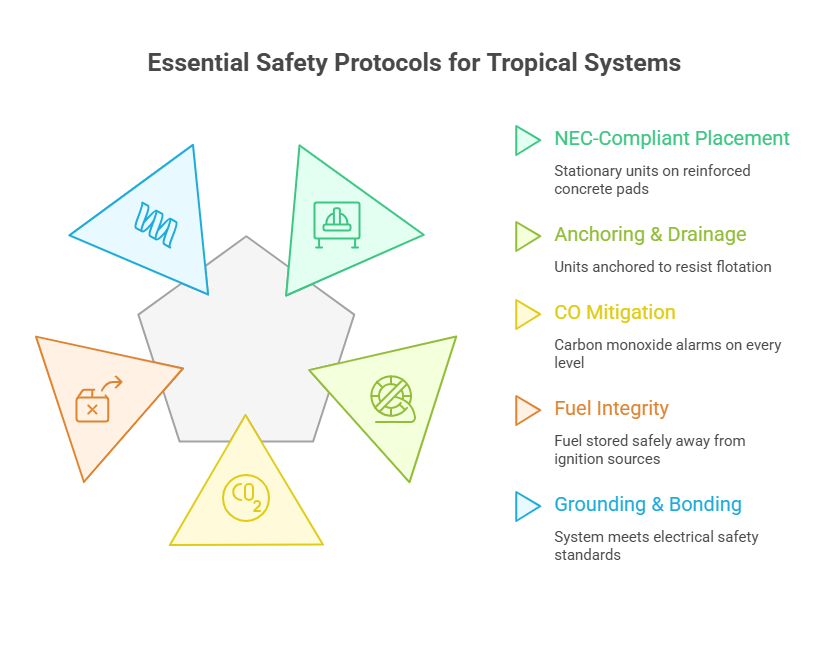
Preparing for hurricane season involves more than filling fuel containers. A flood-safe generator setup forms the foundation of a reliable system. Here are the core safety pillars we implement for every Houston property:
- NEC-Compliant Placement: Stationary units must sit on a reinforced concrete pad at least 6 inches thick, extending beyond the generator skid for secure anchoring.
- Anchoring & Drainage: Per Harris County Floodplain Management and FEMA P-348 guidelines, units must be properly anchored to resist flotation and debris impact in flood-prone areas.
- CO Mitigation: Install UL 2034-listed carbon monoxide alarms on every level of the home to monitor for exhaust seepage during high-wind events.
- Fuel Integrity: Store secondary fuel in NFPA-compliant containers positioned safely away from the engine ignition source.
- Grounding & Bonding: A licensed generator installer must verify that the system meets NEC Article 250 and Article 445 requirements to prevent accidental electrocution.
Adhering to these portable generator safety rules protects your home from fire and electrical surges. For permanent installations, we utilize manufacturer-certified enclosures designed to withstand regional wind speeds, ensuring the unit remains functional after severe weather passes.
Engineering a Secure Electrical Connection
A significant hazard during severe weather is “backfeeding,” which occurs when a generator is connected directly to a wall outlet without proper isolation. This dangerous practice energizes utility lines and endangers linemen. Professional generator safety during hurricanes requires an automatic transfer switch installation (ATS) to provide a physical break from the municipal grid.
Our backup generator storm preparation includes a comprehensive audit of your service entrance equipment. We often perform an electrical panel upgrade for generator compatibility to ensure your breakers can handle the starting current of your central AC. By following generator extension cord safety—using only SOOW-rated, multi-conductor cables—we eliminate the risk of insulation failure in wet conditions.
2026 Regulatory Compliance: Professional vs. DIY
| Safety Standard | Energy Store Professional Install | Standard DIY Setup | Compliance Risk |
| Wind Load (ASCE 7) | Manufacturer-certified enclosure ratings | Unsecured or improperly anchored | Equipment damage or loss |
| Anchoring (FEMA P-348) | Verified flood-resistant anchoring system | Ground level without proper hold-downs | Flotation or debris impact damage |
| Transfer Isolation | UL 1008 Automatic Transfer Switch | Manual interlock (code-compliant if installed correctly) or dangerous “suicide cord” backfeeding | Safety violation or electrocution risk |
| Grounding (NEC 250/445) | Verified equipment grounding conductor bond | Improper or missing ground connection | Electrocution risk |
| Fuel Delivery | Hard-piped natural gas or properly installed propane | Manual liquid refueling in hazardous conditions | Fire hazard during severe weather |
Advanced Flood Mitigation and System Longevity
Houston’s rainfall intensity requires a flood-safe generator setup that accounts for rapid surface water accumulation. If water enters the alternator or control board, the unit may be compromised. We recommend utilizing a properly anchored platform with adequate drainage if your property has a history of ponding. This technical approach to severe weather power backup ensures that your investment survives intense rainfall events typical of Gulf Coast climate patterns.
Pre-season testing is equally vital. In May, we perform comprehensive system testing to verify that the cooling system and voltage regulator can handle full load conditions. A generator system that sits idle for months may have degraded fuel or a weak battery. Routine emergency generator maintenance Houston ensures that when utility power is lost, your backup power engages within the standard 10 to 30 second timeframe.
Local Authority in Houston Power Resilience
At Energy Store Consulting, we integrate engineering precision with local regulatory expertise. Having managed hundreds of projects under the jurisdiction of Houston Public Works and the Harris County Fire Marshal, we understand the exact permitting requirements for standby generator installations. We don’t just provide equipment; we provide a managed safety environment for your family.
Our Houston hurricane generator safety audits cover every vulnerability from gas line pressure to circuit prioritization. We ensure your generator grounding requirements meet current NEC standards for residential dwellings. Trust a local team that understands the intersection of Texas weather patterns and federal safety standards.
FAQ about Generator Safety During Hurricanes
Is it safe to refuel a generator during a severe storm?
No. Never refuel a hot engine. Allow it to cool for at least 10 minutes. For maximum generator safety during hurricanes, stationary natural gas units are preferred as they require no manual refueling in hazardous weather conditions.
How do current electrical codes affect my generator placement?
NEC requirements specify that generator disconnects must be located outdoors and readily accessible. This ensures emergency responders can quickly isolate your generator system if necessary during a hurricane response.
Why is grounding so important for a flood-safe generator setup?
In wet conditions, the risk of stray voltage increases. Proper grounding per NEC Article 250 and 445 directs fault current safely into the earth, preventing the metal enclosure from becoming energized and reducing electrocution risk.
Can carbon monoxide enter my home if the generator is 10 feet away?
Yes. High winds can push exhaust toward soffit vents, window seals, or air intake openings. Maintaining a 20-foot minimum distance is a critical component of generator safety during hurricanes protocols.
What is the “load-side” vs. “line-side” connection?
A professional automatic transfer switch installation connects to the line-side (utility source) and load-side (home distribution). This isolation prevents backfeeding and represents the only code-approved method for severe weather power backup systems.
Request Your Storm Safety Audit
Don’t wait for a tropical warning to verify your system’s integrity. Ensure your home is fully compliant with modern generator safety during hurricanes standards. Our team is ready to provide a technical evaluation of your current setup. Energy Store Consulting – Your Houston Power Experts.
- Phone: 832-990-0672
- Website: https://energystoreconsulting.com/
- Address: 6723 Theall Rd, Suite C-2, Houston, TX